
North Trafford Heat Zone Boundary Consultation
Overview
Respond to our survey to share your views
Have your say on the proposed North Trafford heat network zone boundary
Trafford Council is consulting on the proposed boundary for a ‘heat network zone’ in North Trafford. We want to understand your views on the proposed boundary, as well as understanding any other local considerations.
The consultation opens on Thursday 26 November 2026 and closes at midnight on Friday 22 January 2027. We are hosting four 45-minute online webinars during the consultation. Details of these can be found at the bottom of this page under 'events'.
Once you have read the information below, you can complete the consultation questionnaire. Additional documents can be found at the bottom of this page under the 'related' section.
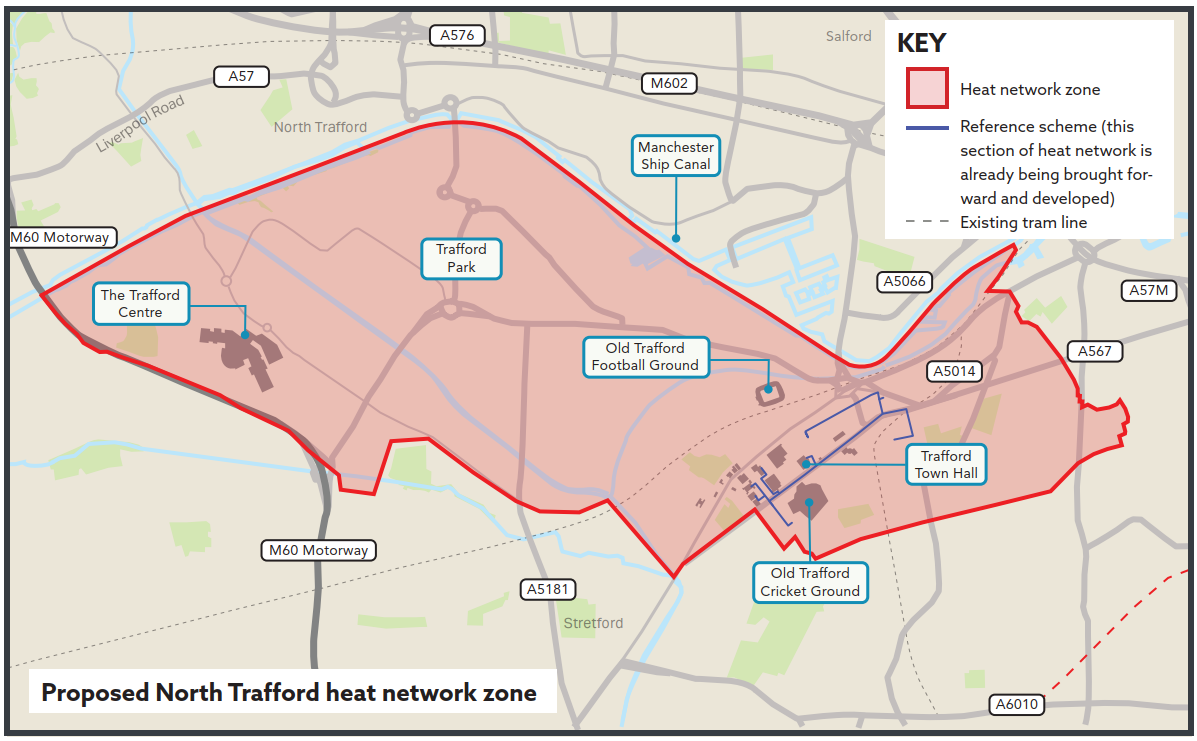
Map of the North Trafford Heat Network Zone proposed boundary edge:
What is a heat network?
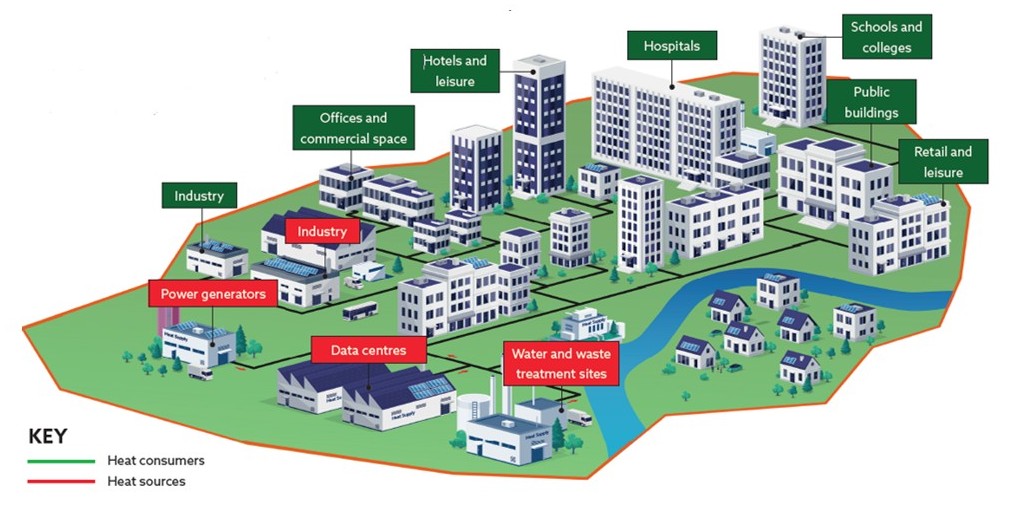
A heat network uses insulated underground pipes to take heating or cooling from a central source and deliver it to more than one building. Heat networks can serve public buildings, shops, offices, education and leisure facilities, residential blocks and other large buildings.
Heat networks can use a range of low-carbon and recovered heat sources, including heat from industrial processes, power generation, data centres, wastewater and waste-treatment facilities, which might otherwise go unused.
The below illustration shows how a heat network works, with heat sources sending heat out to different types of customer. It is not an illustration of the proposed heat network in North Trafford.
What is heat network zoning?
Heat network zoning is the process of identifying and designating areas where heat networks are expected to provide a low-cost, low-carbon heating option. It is intended to give local areas, building owners, heat-network developers and investors greater clarity about where heat networks could be developed.
Not all buildings within a zone will connect at once, or at all. Zone boundaries balance cost, deliverability and carbon reduction. Most connections are expected to be voluntary. Certain types of buildings within a designated zone may be required to connect in the future, subject to the final criteria, notice periods and exemptions that apply. Existing homes with their own individual heating systems are not expected to be required to connect.
|
Reduce carbon emissions significantly |
Deliver carbon savings of approximately 2.5 million tonnes of CO2 equivalent (CO2e) over 40 years, which is roughly 64,000 tonnes of CO2e per year on average, compared to a gas boiler baseline |
|
Reduce air pollution from gas heating |
Improve local air quality by replacing large numbers of individual gas and fossil fuel heating systems in a heavily built-up, industrial and commercial area with centralised low-carbon heat sources |
|
Save building owners money on heating costs |
Provide one of the lowest-cost ways to decarbonise heat at scale in the area over the long term, with the potential for more stable heating costs as networks develop |
What is being proposed?
The proposed North Trafford heat network zone is an area where heat networks are expected to provide a practical, low-carbon way of heating buildings at scale. The proposed boundary has been developed using national zoning modelling, local evidence and information about building heat demand, building density, potential anchor buildings, low-carbon heat sources, deliverability, and planned development. Connecting to a heat network can provide reliable, future-proof, low-carbon heating and hot water, helping to reduce emissions, improve energy efficiency, save space, support local economies, and potentially deliver more stable long-term energy costs.
Early investigations indicate that a heat network here could significantly reduce carbon emissions, improve local air quality by replacing individual fossil-fuel heating systems, and provide a cost-effective way to decarbonise heat at scale, with the potential for more stable heating costs as networks develop. The proposed zone is centred on North Trafford and includes the Civic Quarter reference heat network scheme – a section of heat network around the Civic Quarter that is already being brought forward and developed.
The boundary remains subject to consultation and may be refined where relevant evidence or local information identifies an opportunity, error, omission or deliverability issue.
Please click here to view a plan of the proposed boundary.
Why your views matter
What is this consultation about?
We are seeking feedback on:
- the proposed North Trafford heat network zone boundary;
- whether the boundary appropriately includes relevant buildings and potential low-carbon heat sources;
- any local evidence, planned development or practical constraints that should be considered;
- any errors, omissions or suggested changes to the proposed boundary; and
- whether you agree or disagree with the proposed boundary, and why.
What this consultation is not about
This consultation will not determine:
- whether heat network zoning should happen in principle;
- the final design or route of any heat network;
- construction methods or construction dates;
- commercial tariffs or final connection costs; or
- whether or when an individual building will connect.
Who should take part?
The consultation is open to everyone. We particularly want to hear from:
- owners and occupiers of commercial buildings within the proposed zone;
- businesses, developers and landlords;
- existing heat-network operators and organisations responsible for potential heat sources;
- utilities, transport organisations and other statutory bodies;
- business groups who may have an interest in future heat network zone designation and / or operation
- people who live or work within or close to the proposed boundary; and
- organisations and authorities with interests in neighbouring areas, including Manchester and Salford.
How to respond
Please review the proposed boundary and supporting information before completing the online questionnaire. Your response should focus on the proposed boundary and any relevant local evidence or information that may affect it.
Complete the online questionnaire by Friday 22 January 2027.
If you have a question about the consultation or require support to respond, contact the consultation team: NorthTraffordZoneBoundary@aecom.com
We are also hosting a series of online presentation and Q&A sessions. Each session will include a short presentation followed by an opportunity to ask questions. Sessions are offered at different times of day to make it easier for businesses, organisations and members of the public to attend. Add one to your calendar by following the joining links at the bottom of the page.
What happens after the consultation?
After the consultation closes, all responses received through the questionnaire, webinars and consultation correspondence will be reviewed and analysed. The proposed zone boundary will be reviewed based on the consultation feedback and we will consider whether any changes need to be made.
Trafford Council will publish a public report explaining how the consultation was undertaken, summarising the main issues raised and setting out how the feedback has been considered.
The below activities will also feed into future delivery of the heat network zone.
- Working with our selected developer, Vital Energi, to design and build the heat network once the final zone has been designated.
- Identifying potential locations for a central heat source.
- Talking to potential producers of waste heat to gauge their interest in connecting to the network for their waste heat to be used via the central source.
- Talking to some building owners who may be required to connect or will be using the network to understand their needs.
- Talking to other key stakeholders to ensure we continue to understand key opportunities and constraints to identify the best approach for a heat network in Trafford.
- Work will be closely coordinated with that of other infrastructure operators such as highways, rail and utilities, to help ensure every opportunity is taken to join up on construction works already planned, to avoid multiple disruptions.
How we will use your information
Information submitted through the consultation will be handled in accordance with applicable data-protection requirements and Trafford Council’s consultation privacy notice.
Accessibility and alternative formats
If you need this information in an alternative format or require support to take part in the consultation, please contact the consultation team: NorthTraffordZoneBoundary@aecom.com
Further information
More information about heat network zoning is available from the UK Government: www.gov.uk/government/collections/heat-network-zoning
For questions specifically about this consultation, contact: NorthTraffordZoneBoundary@aecom.com
Events
-
Heat Zone Boundary Consultation webinar
From 2 Dec 2026 at 08:15 to 2 Dec 2026 at 09:00Location Online -
Heat Zone Boundary Consultation webinar
From 15 Dec 2026 at 12:30 to 15 Dec 2026 at 13:15Location Online -
Heat Zone Boundary Consultation webinar
From 7 Jan 2027 at 10:30 to 7 Jan 2027 at 11:15Location Online -
Heat Zone Boundary Consultation webinar
From 13 Jan 2027 at 14:30 to 13 Jan 2027 at 15:15Location Online